title: Sciarid Fly category: pests tags: - sciarid fly - fungus gnat - propagation - substrate pests - biological control
Sciarid Fly
Overview
Sciarid flies (commonly called fungus gnats) are one of the most common substrate-related pests in protected horticulture.
They are especially important in:
- propagation
- young plant production
- plug production
- herb crops
- ornamentals
- strawberries
- hydroponics
- wet substrate systems
The adult flies are mainly a nuisance and monitoring indicator, but the larvae are the damaging stage.
Larvae feed within the substrate and can damage: - young roots - root hairs - stem bases - germinating seedlings
Sciarid fly pressure is strongly linked to: - excessive substrate moisture - algae - organic debris - poor hygiene - stagnant humid conditions
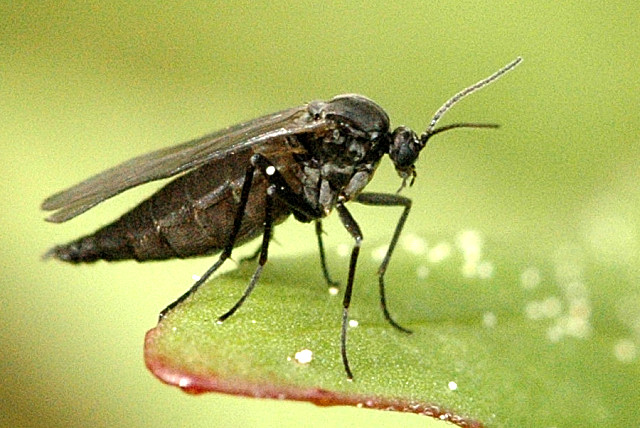
Identification
Adults
Adult sciarid flies are:
- small dark flies
- weak fliers
- often seen running across compost or media
- attracted to moist areas
- commonly found around propagation benches
Adults are usually: - 2–4 mm long - dark grey to black - mosquito-like in appearance
They are commonly confused with: - shore fly - small midges - vinegar flies
Larvae
Larvae are: - translucent white - worm-like - legless - with distinct shiny black heads
They are usually found: - near the substrate surface - around roots - beneath algae or wet organic matter
Life cycle
Sciarid flies reproduce rapidly in warm moist conditions.
Typical cycle:
| Stage | Approximate duration |
|---|---|
| Egg | 3–6 days |
| Larva | 10–14 days |
| Pupa | 3–6 days |
| Adult | About 1 week |
Warm protected environments can allow continuous breeding.
Multiple overlapping generations are common.
Damage symptoms
Root damage
Larval feeding can cause: - reduced root growth - weak rooting - transplant stress - poor uptake - stunting
Young crops are most vulnerable.
Stem-base damage
Heavy larval feeding may cause: - stem collapse - damping-off type symptoms - poor establishment
This is most serious in: - seedlings - plugs - propagation trays
Disease association
Sciarid flies may contribute to spread of: - Pythium - Fusarium - damping-off organisms
This is one reason why high sciarid populations are important even when direct feeding damage appears limited.
Conditions favouring sciarid fly
| Condition | Risk effect |
|---|---|
| Wet substrate | Very High |
| Algae growth | Very High |
| Poor airflow | High |
| Overwatering | High |
| Organic debris | High |
| Dense propagation | Moderate–High |
| Cool wet media | Moderate |
| Standing water | High |
Seasonal activity (UK)
Although sciarid flies can breed throughout the year in heated glasshouses and propagation units, outdoor populations usually follow a seasonal pattern.
| Month | Typical activity |
|---|---|
| January–February | Low outdoor activity, continued breeding in heated propagation |
| March | Increasing adult activity |
| April–June | Rapid population growth |
| July–August | Peak breeding period |
| September | Continued high pressure in protected crops |
| October | Declining outdoor populations |
| November–December | Mainly protected-crop activity |
In heated propagation facilities, overlapping generations may occur continuously.
Sciarid fly or Shore fly?
These two insects are commonly confused.
| Feature | Sciarid fly | Shore fly |
|---|---|---|
| Adult colour | Black-grey | Dark with pale markings |
| Larvae with black head | ✔ Yes | ✖ No |
| Root feeding | ✔ Yes | Usually no |
| Main damage | Root feeding | Mainly nuisance/algae indicator |
| Biological control | Important | Usually unnecessary |
Correct identification is important before introducing biological control.
Monitoring
Sticky traps
Yellow sticky traps help monitor adult populations.
Useful for: - trend monitoring - hotspot detection - assessing biological control performance
High adult numbers usually indicate active breeding inside the substrate.
Substrate inspections
Inspect: - beneath trays - wet corners - algae zones - propagation benches - around drippers and leaks
Look for: - larvae - algae - wet stagnant areas
Potato slice monitoring
Potato slices placed on substrate can attract larvae beneath them.
Useful for: - confirming larval presence - locating hotspots - estimating pressure
Biological control
Sciarid flies are usually best controlled using integrated programmes.
Predatory mites (see Stratiolaelaps scimitus)
Common biological approaches include substrate predatory mites such as:
- Hypoaspis-type systems
- Stratiolaelaps-type predators
These feed on: - eggs - larvae - pupae
Most effective: - preventatively - before populations explode
Beneficial nematodes (Steinernema feltiae)
Entomopathogenic nematodes can help suppress larvae in moist substrate systems.
Most effective when: - substrate moisture is suitable - applications are repeated correctly - populations are still manageable
Rove beetles (Atheta coriaria)
Atheta-type rove beetles are often highly effective in: - propagation - organic-rich systems - long-season crops
They help suppress: - larvae - pupae
Environmental management
Environmental control is critical.
Useful practices include:
- avoiding overwatering
- improving dry-down
- reducing algae
- fixing leaks quickly
- improving airflow
- removing old organic debris
- reducing standing water
Sciarid management usually fails when the environment continuously favours breeding.
Propagation risk
Propagation systems are especially vulnerable because: - substrates remain moist - roots are highly sensitive - crops are dense - hygiene challenges increase - biological systems may not yet be established
This makes prevention extremely important.
Common hotspot areas
High-risk zones include:
- under benches
- around irrigation leaks
- algae-covered floors
- wet corners
- propagation tunnels
- standing water zones
- old substrate piles
Practical IPM strategy
A strong sciarid fly IPM programme usually combines:
- environmental correction
- algae reduction
- preventative predators
- substrate monitoring
- irrigation management
- hygiene
- hotspot treatment
Biological control alone rarely succeeds if substrate conditions remain excessively wet.
Common host plants
Sciarid flies are associated with moist growing media rather than specific plant species, but they are particularly common in propagation and protected crops.
Frequently affected plants include:
Visit the Plant Database to see the other pests commonly associated with each crop.
Related BioWiki pages
Key message
Sciarid fly problems are usually environmental problems first.
The strongest programmes focus on: - substrate management - moisture control - hygiene - preventative biological control - early hotspot detection