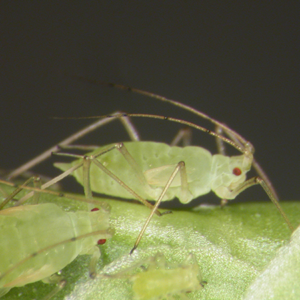
Aphids
Overview
Aphids are one of the most common pest groups in horticulture.
They feed on plant sap and are strongly associated with:
- soft growth
- high nitrogen
- protected crops
- mild conditions
- dense canopies
- young shoots and growing points
Aphids are important because they can:
- distort growth
- produce honeydew
- reduce crop quality
- spread viruses in some crops
- disrupt biological control programmes if allowed to build
Identification
Aphids are soft-bodied insects found in colonies.
They may be:
- green
- black
- yellow
- pink
- grey
- brown
Look for:
- colonies on young shoots
- curled leaves
- sticky honeydew
- white cast skins
- ants
- distorted growing points
- winged aphids
Winged aphids are an important early warning sign of movement into or around the crop.
Aphids reproduce extremely quickly. Under favourable conditions a single aphid can establish a large colony within a short period, making early detection far more effective than attempting to control established infestations.
Damage symptoms
Typical symptoms include:
- curled leaves
- distorted shoots
- stunted growth
- sticky leaves
- sooty mould
- flower contamination
- poor visual quality
- reduced vigour
Damage is often worst on soft new growth.
Damage progression
Typical aphid infestations develop in stages.
- Winged aphids arrive on soft new growth.
- Small colonies establish.
- Colonies expand rapidly.
- Honeydew accumulates.
- Sooty mould develops.
- Leaves curl around colonies.
- Biological control becomes progressively more difficult.
Conditions favouring aphids
| Condition | Risk |
|---|---|
| Soft rapid growth | Very High |
| Excess nitrogen | High |
| Mild protected conditions | High |
| Dense canopy | Moderate |
| Low predator activity | High |
| Weed reservoirs | Moderate–High |
| Crop carryover | High |
Seasonal activity (UK)
Although aphids can occur throughout the year in protected crops, their activity usually follows a seasonal pattern.
| Month | Typical activity |
|---|---|
| January–February | Slow development in protected crops |
| March | Winged aphids begin colonising new crops |
| April–June | Rapid colony expansion |
| July–August | Peak populations |
| September | Continued activity during mild weather |
| October | Winged forms disperse |
| November–December | Reduced outdoor activity but continued risk in protected crops |
In heated glasshouses aphids may reproduce continuously throughout the year.
Monitoring
Inspect:
- growing points
- undersides of young leaves
- flower stems
- crop edges
- soft flushes of growth
- weeds near the crop
Check for:
- winged aphids
- early colonies
- honeydew
- cast skins
- mummified aphids
Aphid mummies can show parasitoid activity.
Hotspot behaviour
Aphids often start in small colonies.
Common hotspot areas include:
- soft growth zones
- crop edges
- near doors and vents
- warm sheltered areas
- stressed plants
- weeds
- old crop residues
Early colonies should be mapped and revisited.
Biological control strategy
Aphid biological control usually works best when started early.
Useful strategies include:
| Beneficial | Best suited for |
|---|---|
| Aphidius parasitoids | Early colony suppression |
| Aphidoletes | Established colonies |
| Ladybirds | Medium to large infestations |
| Lacewing larvae | Mixed aphid stages |
| Banker plant systems | Long-term preventative programmes |
Preserving naturally occurring predators is an important part of successful IPM.
Biological control is much more successful before leaves become heavily curled and colonies become protected.
Crop balance and nutrition
Aphids are strongly influenced by crop growth balance.
High soft growth can increase risk.
Useful crop-management actions:
- avoid excessive nitrogen
- avoid overly soft vegetative growth
- maintain balanced irrigation
- reduce crop stress
- avoid repeated disruption of natural enemies
Common host plants
Aphids attack hundreds of plant species, particularly those producing soft, actively growing shoots.
Common hosts include:
Many additional host plants are included within the Biopredator Plant Database.
View the complete Plant Database to discover other pests commonly associated with each crop.
Often confused with
Aphids are sometimes confused with:
- Whitefly
- Mealybugs
- Psyllids
- Soft scale insects
Correct identification is important because different biological control agents are required for each pest group.
Related BioWiki pages
Aphid species
'Aphids' refers to a large group of closely related insects rather than a single species.
Different aphid species have different host preferences and can vary in colour, biology and virus transmission, but the principles of monitoring, early detection and integrated biological control remain broadly the same.
Key message
Aphid management is easiest before colonies become dense.
Find winged aphids and early colonies quickly, protect natural enemies and avoid producing excessively soft growth.
Use this page alongside
- Check current aphid weather risk
- Biocontrol Tool
- Release Planner
- Risk Engine
- Pest ID Tool
- Plant Database
- BioWiki Home