tags: - public-ready - export-bio - index
Woolly Aphid
Common names: Woolly Aphid Scientific name: Eriosoma lanigerum
Overview
Woolly aphids are sap-feeding aphids characterised by white waxy protective coverings.
They are particularly associated with:
- apple systems
- woody hosts
- orchard production
- ornamental shrubs
- nursery stock
Colonies often develop on stems, pruning wounds and woody growth.
Identification
Typical signs include:
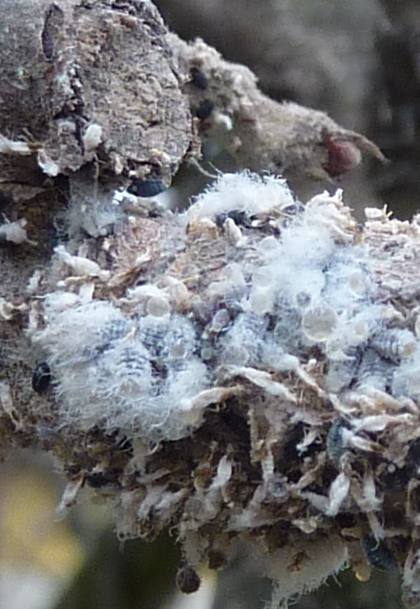
- white cotton-like wax masses
- clustered stem colonies
- bark crevices occupied by aphids
- sticky honeydew
- black sooty mould
- swelling or distortion around feeding sites
The wax covering helps protect colonies from environmental stress and some natural enemies.
Crop impact
Woolly aphid infestations may cause:
- weakened growth
- bark damage
- shoot distortion
- contamination
- stress around pruning sites
- reduced plant vigour
Heavy infestations may weaken young trees and nursery stock.
Environmental drivers
Pressure often increases during:
- warm growing conditions
- dense canopy development
- low airflow
- vigorous soft growth
- poorly balanced pruning systems
Colonies can persist within sheltered woody structures.
See: - Temperature - Ventilation and air movement
Biological control relevance
Biological suppression depends heavily on:
- natural enemy continuity
- environmental suitability
- long-term ecological balance
- avoidance of disruptive spray programmes
Predator and parasitoid activity may help regulate populations where systems remain stable.
IPM considerations
Integrated Pest Management programmes should focus on:
- early colony detection
- pruning hygiene
- hotspot removal
- balanced vegetative growth
- preservation of beneficial insects
- orchard ecological stability
Repeated disruptive interventions may destabilise natural suppression systems.
Monitoring strategy
Useful monitoring approaches include:
- inspection of pruning wounds
- branch and stem scouting
- hotspot mapping
- monitoring regrowth zones
- checking sheltered canopy areas
Monitoring should focus on colony expansion and persistence through the season.