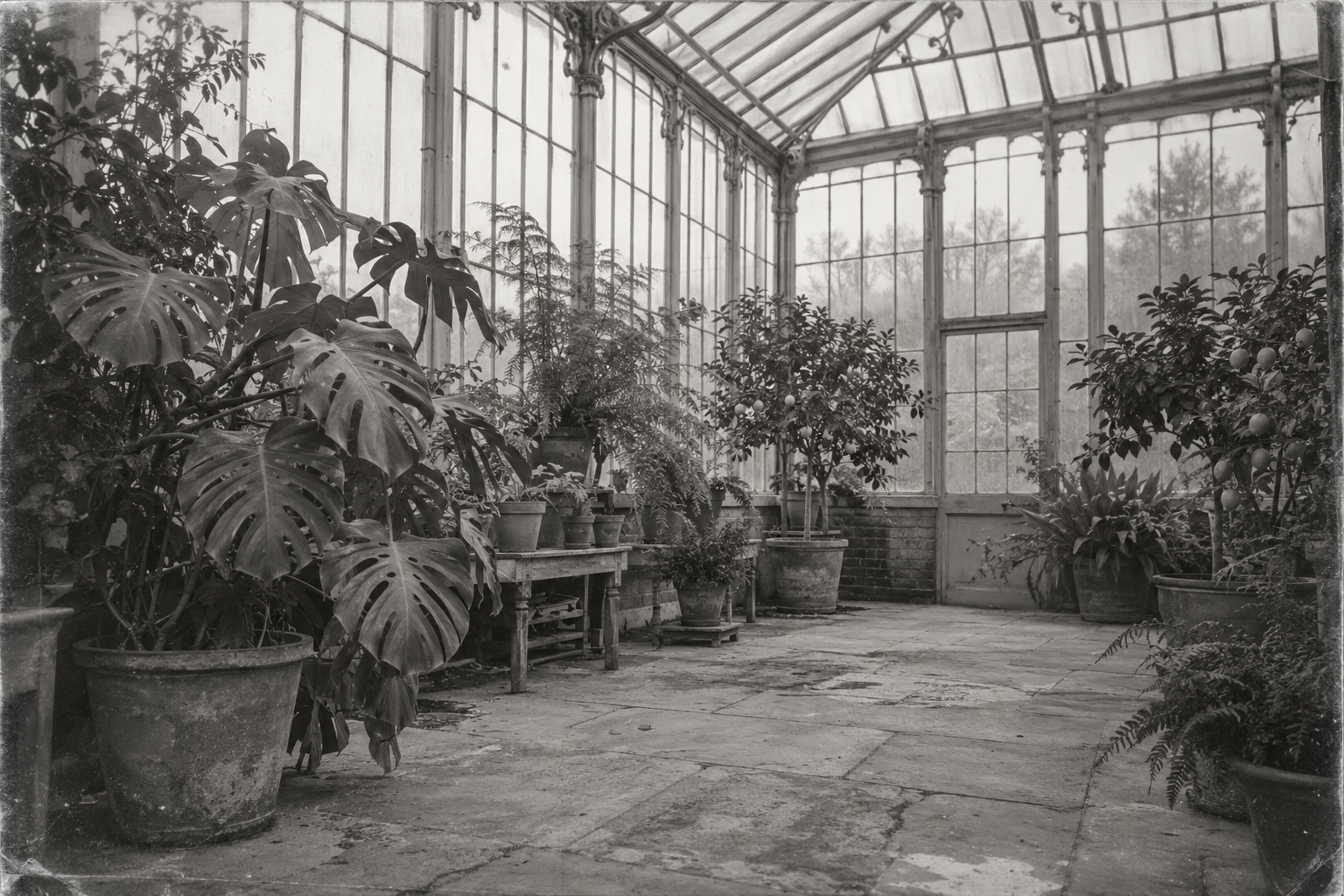
What would pest control have looked like in 1870?
That was 156 years ago. No sachets of predatory mites, no weekly delivery of parasitoid cards, and no computer adjusting the glasshouse climate. Yet growers were already dealing with familiar problems, and some of the foundations of biological control were beginning to take shape.
Reading Victorian horticultural advice, what strikes me is the mixture of careful observation, practical growing knowledge and fairly aggressive attempts to kill whatever was eating the plants.
Shirley Hibberd’s The Amateur’s Greenhouse and Conservatory lists greenfly, blackfly, thrips, red spider and scale among the main glasshouse problems. It connects outbreaks with inadequate watering, poor ventilation and plants in poor condition. Alongside that advice came tobacco fumigation, washing, dipping and painstakingly sponging individual leaves. These were labour-intensive practices, and the tobacco treatments belong firmly in the history books. (en.wikisource.org)
But another line of enquiry was developing. Could growers deliberately use the insects that were already attacking their pests?
By the 1880s, this was becoming a practical undertaking.
In 1883, the parasitoid wasp now known as Cotesia glomerata was introduced into North America to control the imported cabbageworm, the caterpillar of the small white butterfly. This was a deliberate attempt to establish a natural enemy against an introduced crop pest. The wasp lays its eggs inside caterpillars, where its young develop before emerging and spinning their cocoons. (cals.cornell.edu)
That means people were collecting and transporting beneficial wasps for crop protection more than 140 years ago.
Then came the ladybird story that helped demonstrate just how powerful biological control could be.
Cottony cushion scale was devastating California’s developing citrus industry. Charles Valentine Riley, heading the United States Department of Agriculture’s entomological work, sent Albert Koebele to Australia to investigate the pest’s natural enemies.
Koebele found the vedalia ladybird feeding on the scale and arranged shipments to California between November 1888 and March 1889. Cornell’s historical account records just 514 beetles arriving and being released. Their descendants brought the pest under dramatic control, making the project a landmark in biological pest management. (biocontrol.entomology.cornell.edu)
What interests me is the question behind that work: what was keeping this insect under control in its original environment?
Following that question led researchers to a useful predator and, eventually, a practical solution. It was a substantial step towards treating pest problems as relationships between organisms.
The next part of the story brings us much closer to the British glasshouse.
If you work in horticulture, Encarsia formosa will probably be a familiar name. Its commercial use against greenhouse whitefly dates to 1927. Historical accounts describe an English tomato grower noticing blackened whitefly scales in 1926, from which tiny parasitoid wasps emerged. By the following year, the wasp was being used commercially in England. (ask.ifas.ufl.edu)
So your great-grandparents’ generation could have encountered glasshouse whitefly being controlled with beneficial wasps.
Edward R. Speyer, working at the Experimental and Research Station at Cheshunt, published his account of Encarsia in March 1927. He described the blackening of parasitised whitefly, the emergence of adult wasps and the difficulties caused by low temperatures. He also considered how to distribute the parasitoid between crops. Moving branches carrying parasitised whitefly could work, but brought a risk of transferring other pests and diseases. (cambridge.org)
That feels remarkably familiar. Finding a beneficial insect was only the beginning. Growers also needed to understand its biology, provide suitable conditions and introduce it without creating another problem.
The development of biological control was not a steady march forward. The growing popularity of synthetic insecticides after the Second World War reduced demand for Encarsia. Later concerns about insecticide resistance helped renew interest in biological methods. (ask.ifas.ufl.edu)
I wouldn’t call Victorian horticulture modern IPM. These early introductions were also different from the regular releases used in many protected crops today. But the history does show how long people have been turning knowledge of insects into practical crop protection.
For me, that is the interesting connection between a Victorian citrus orchard, a 1920s tomato glasshouse and a modern nursery.
Someone looked closely enough to notice that the pest had an enemy. Then they asked whether that relationship could help the grower.
We have developed an enormous amount of science and technology around that question. It is still a very good question.